
A great Dubai asset can lose much of its appeal if the ownership structure is misunderstood at the start. For international buyers, foreign ownership rules in Dubai are not a footnote to the transaction. They shape what you can buy, where you can buy it, how you can hold it, and what kind of long-term control you actually have.
For serious investors, that distinction matters. Dubai is one of the most accessible property markets in the world for overseas buyers, but accessibility does not mean every asset comes with identical rights. The real advantage lies in understanding the legal framework well enough to separate true strategic ownership from attractive marketing.
What foreign ownership rules in Dubai actually allow
The short answer is that foreigners can own property in Dubai, including full ownership rights in designated areas. This is the point many buyers know. What they often miss is that the rule is area-specific and right-specific.
Dubai permits non-UAE nationals to buy real estate in designated zones that are commonly referred to as freehold areas. In these locations, an overseas investor can typically acquire full ownership of the property, with the right to sell, lease, occupy, or pass it on through inheritance planning subject to applicable procedures.
Outside those designated areas, ownership rights may be more limited or structured differently. In practice, most international residential investment activity is concentrated in the freehold market, which is why Dubai has become such a strong magnet for cross-border capital.
That said, investors should avoid treating the phrase freehold as if it answers every legal question. It does not. The practical value of ownership still depends on the title structure, the underlying master development, service charge exposure, developer quality, financing terms, and your intended hold period.
Freehold vs leasehold under foreign ownership rules in Dubai
For most global investors, the key distinction is between freehold and leasehold.
Freehold gives the buyer full ownership rights over the property in a designated area. In an apartment, that usually means ownership of the individual unit plus a proportionate interest in common areas governed by the building and community framework. In a villa, the rights may extend to land use within the title parameters, depending on the development.
Leasehold, by contrast, grants the right to use or occupy a property for a fixed term, often long-term, rather than permanent title ownership. The exact duration and conditions vary. A leasehold asset may still be commercially viable, especially if pricing is favorable and the exit horizon is clear, but it is a different proposition from owning the title outright.
This is where disciplined buyers slow down. A property that appears attractively priced may reflect a weaker ownership profile, shorter residual term, or tighter transfer conditions. For a capital preservation strategy, those details are not secondary.
Where foreign buyers can purchase in Dubai
Foreign buyers are generally active in designated freehold areas across Dubai, including many of the city’s best-known residential and mixed-use districts. These zones were created to attract international capital and have become central to Dubai’s growth as a global real estate market.
From an investment perspective, the question is not simply whether an area permits foreign ownership. It is whether the specific submarket aligns with your objective. A waterfront trophy address, a branded residence, a family-oriented villa community, and a business-centric urban district can all fall within the permitted ownership framework while offering very different risk-return profiles.
This is one reason sophisticated buyers do not select location based on popularity alone. They assess tenant depth, supply pipeline, developer track record, service fee burden, resale liquidity, and whether the community’s long-term positioning supports pricing discipline.
Do mainland business ownership rules affect property buyers?
This is a common source of confusion. Some investors hear about UAE corporate ownership reforms and assume they apply directly to every real estate purchase. They do not.
There are separate legal considerations for business ownership and property ownership. The liberalization of company ownership in many sectors across the UAE has improved the overall investment climate, but buying a Dubai property is governed through the property regime, title registration framework, and the rules that apply to the specific area and asset class.
The overlap becomes relevant when an investor is deciding whether to buy as an individual, through an offshore entity, or through another corporate structure. In those cases, structuring, tax treatment in the investor’s home jurisdiction, financing access, compliance obligations, and succession planning all become highly relevant. The best structure is rarely universal. It depends on portfolio size, intended use, and cross-border planning priorities.
How title and registration work
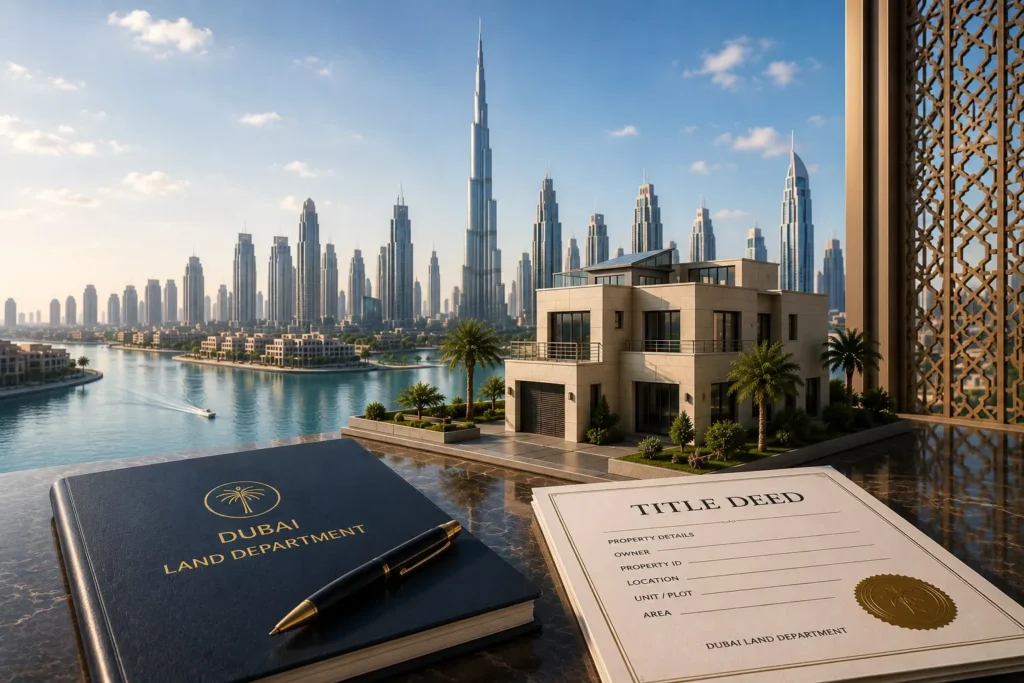
Ownership rights in Dubai are formalized through registration, not informal contract language alone. The Dubai Land Department plays a central role in recording and validating property interests, while the market’s regulatory framework has helped support investor confidence over time.
For completed property, what matters is that the title position is clear, transferable, and properly registered. For off-plan purchases, investors need to pay close attention to the sales agreement, project approvals, escrow arrangements, construction milestones, and the developer’s delivery credibility.
This is also where many overseas buyers underestimate execution risk. A strong legal framework improves confidence, but it does not eliminate the need for due diligence. A premium-looking launch is not the same thing as a premium asset.
Mortgages, inheritance, and holding strategy
Foreign ownership rules in Dubai may allow acquisition, but financing and succession planning introduce another layer of decision-making.
Non-resident buyers can often access mortgage financing, although loan-to-value ratios, eligibility, and pricing may differ from those for residents. Cash buyers have speed and negotiation advantages, but leverage can improve portfolio efficiency when used carefully. The right choice depends on whether the objective is yield optimization, liquidity preservation, or long-term capital positioning.
Inheritance is another area where proactive planning matters. Owning property in Dubai without a clear estate strategy can create avoidable complications for heirs. Investors with family wealth considerations should treat succession planning as part of the acquisition process, not an administrative task to revisit later.
Common mistakes overseas investors make
The first mistake is assuming that if foreigners can buy in Dubai, every transaction is equally straightforward. It is not. The difference between a strong acquisition and a weak one usually appears in the details – title quality, service charges, developer risk, handover certainty, and exit liquidity.
The second mistake is focusing exclusively on launch pricing. A lower entry price can be attractive, but only if the asset’s long-term market position is defensible. In oversupplied pockets, headline discounts can disappear quickly when resale competition intensifies.
The third mistake is choosing based on brochure appeal rather than investment logic. Views, branding, and amenities matter, but they should support the fundamentals, not replace them. Sophisticated capital looks for alignment between legal clarity, location strength, and realistic future demand.
What strategic buyers should evaluate before purchasing
Before moving forward, investors should confirm the exact ownership rights attached to the asset, the status of the project, the reputation and balance sheet strength of the developer, and the total cost of hold. They should also assess whether the property is intended for personal use, income generation, or appreciation-led resale.
Those goals produce different answers. A family acquiring a second home may prioritize lifestyle utility and long-term security. A yield-focused investor may care more about leasing depth, operating costs, and tenant resilience. A corporate buyer may be looking at portfolio diversification and jurisdictional exposure. The legal framework may permit all three approaches, but the right asset for each is rarely the same.
For buyers entering from the US or other international markets, the smartest approach is structured, not reactive. That means understanding the ownership category, pressure-testing the assumptions behind the return story, and buying in locations where demand is durable rather than temporary.
This is where a selective advisory approach adds real value. Firms such as RAD Global focus less on broad inventory and more on identifying assets where title clarity, market quality, and long-term positioning align.
Dubai remains one of the few global markets where international investors can secure meaningful real estate exposure with relatively direct access. The opportunity is real, but so is the gap between buying property and buying well. When ownership rights, asset quality, and investment purpose are properly matched, the result is not just acquisition – it is control, flexibility, and a stronger foundation for long-term value.