

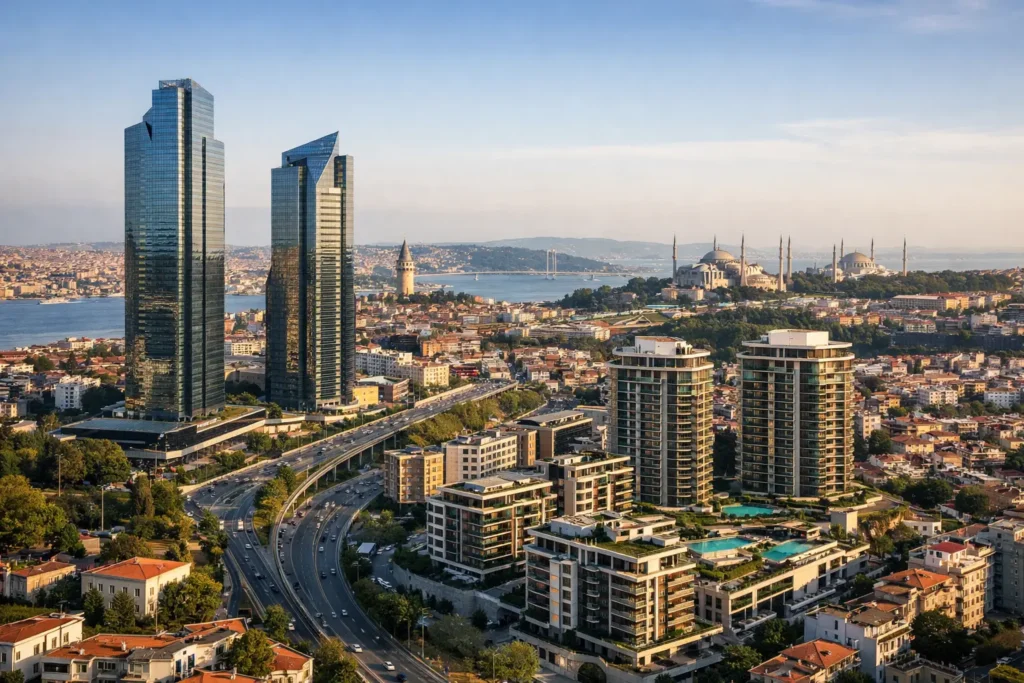
A district can look impressive on a brochure and still underperform as an investment. In Istanbul, the difference between a lifestyle purchase and a high-performing asset often comes down to micro-location, infrastructure timing, and buyer depth. That is why serious investors studying capital appreciation areas in Istanbul should look past headline demand and focus on where pricing power is still building.
Istanbul remains one of the few major gateway cities where scale, demographics, tourism, trade, and urban transformation continue to intersect in a meaningful way. For international buyers, that creates opportunity, but not evenly. Some neighborhoods are already mature and largely priced in. Others are still in the phase where connectivity upgrades, mixed-use development, and changing buyer profiles can materially lift value over the next cycle.
What drives capital appreciation areas in Istanbul
Capital growth in Istanbul rarely happens for one reason alone. The strongest districts usually benefit from several demand engines moving at once. Transport expansion is often the most visible catalyst, especially where metro integration shortens travel time to business centers or airports. Urban regeneration also matters, particularly in districts where aging stock is being replaced by higher-spec residences, branded projects, and mixed-use schemes.
The second layer is buyer quality. A neighborhood can see transaction volume without seeing durable appreciation if demand is driven mainly by short-term speculation or discount-led sales. More resilient growth tends to come from areas that attract end users, corporate tenants, upper-middle-income domestic buyers, and international purchasers with a longer holding horizon. That depth supports resale liquidity, which is just as important as the purchase price.
The final layer is pricing discipline. Investors often assume the fastest-growing area is the best entry point. Sometimes the opposite is true. If launch prices have already run ahead of rental fundamentals or local affordability, upside can narrow quickly. In Istanbul, disciplined entry matters more than chasing momentum.
Basaksehir and Bahcesehir – planned growth with broad demand
For many investors, Basaksehir remains one of the most credible capital appreciation areas in Istanbul because it combines large-scale planning with infrastructure, family-oriented demand, and a modern housing profile. It has long attracted both domestic and international buyers seeking newer inventory, organized communities, and proximity to healthcare and transport links.
Its appeal is not purely cosmetic. Basaksehir benefits from a development pattern that feels more institutional than fragmented. That tends to support price stability and makes the district easier to underwrite for medium-term growth. The buyer pool is also broad, which matters in uncertain cycles.
Nearby Bahcesehir offers a slightly different proposition. It is often favored by buyers who want a greener residential setting without fully sacrificing connectivity. Appreciation here can be strong when projects are positioned near key transport corridors and delivered by credible developers. The trade-off is that not every scheme carries equal resale strength. Project selection matters more than district branding.
Kagithane – centrality, regeneration, and pricing tension
Kagithane has moved from overlooked to widely watched, and for good reason. Its location between major business and lifestyle hubs gives it a strategic advantage that many outer districts cannot match. Proximity to Levent, Maslak, Sisli, and Beyoglu has helped reposition it from a secondary residential area into a serious investment zone.
Urban transformation has been the central story here. As older stock gives way to new developments, the district has become more attractive to younger professionals, investors, and tenants priced out of neighboring prime locations. That migration effect can be powerful for capital growth.
Still, Kagithane is no longer an undiscovered play. In some projects, pricing already reflects much of the regeneration narrative. Investors need to distinguish between genuinely well-located assets and developments relying on district hype alone. In this market, a five-minute difference in access can change long-term performance.
Atasehir – business gravity on the Asian side
Atasehir stands out because it is tied to a clear commercial identity. As a major financial and business district on the Asian side, it benefits from a tenant base and buyer profile that support both rental demand and long-term value retention. For investors who prefer markets with a professional end-user foundation, Atasehir deserves close attention.
What makes the district compelling is its balance. It is not only a workplace destination. It also offers established residential communities, quality schools, retail infrastructure, and a more organized urban feel than many competing zones. That combination can support appreciation more consistently than purely speculative growth areas.
The caveat is entry cost. Better-positioned assets in Atasehir often come at a premium, and that compresses room for error. The upside is usually strongest in developments with enduring design quality, strong management, and direct appeal to executive tenants or owner-occupiers. Commodity stock is less persuasive here.
Zeytinburnu and the coastal belt – prestige with constrained supply
When investors want a premium location with a legacy angle, the coastal belt around Zeytinburnu enters the discussion. This is not a mass-market growth story. It is a supply-constrained, prestige-driven market where sea views, branded residential concepts, and access to the historical center can support long-term value.
The appreciation case here is rooted in scarcity and positioning. Waterfront or near-waterfront opportunities in Istanbul are limited, and well-executed projects in this corridor tend to attract affluent domestic buyers, Gulf investors, and internationally mobile families. That profile can be especially relevant for those balancing investment goals with lifestyle use or citizenship considerations.
The trade-off is straightforward. Capital preservation may be stronger than explosive upside if you enter at the top end of pricing. This is often a lower-risk, lower-yield, quality-first allocation rather than a pure value play. For many sophisticated buyers, that is exactly the point.
Kartal and Maltepe – long-view potential on the Asian coast
Kartal and Maltepe offer a different version of the coastal growth thesis. They provide sea access, improving urban infrastructure, and relative value compared with some established prime districts. For investors willing to take a longer view, these areas can offer an attractive mix of lifestyle demand and development-led appreciation.
Kartal, in particular, has benefited from commercial expansion and better transport connectivity. Maltepe adds a stronger residential identity and broader appeal to families. In both districts, newer developments with sea views or easy transit access tend to outperform the average stock.
These are not automatic wins. Some projects oversell the district narrative without delivering the quality needed for premium resale. Investors should be especially careful around execution risk, maintenance standards, and exact positioning. The Asian side can reward patience, but only when the asset itself is strong.
What sophisticated investors should screen before buying
District selection is only the first filter. The second is whether the specific property can outperform within that district. A weak project in a strong area can still become a mediocre asset. By contrast, a well-priced, well-managed residence in the right micro-market can compound quietly and effectively over time.
The first question is developer credibility. Delivery history, construction quality, and post-handover management matter more than marketing language. The second is local liquidity. Investors should understand who the likely future buyer is and whether that audience is expanding. The third is pricing relative to nearby completed stock, not just the developer’s own launch narrative.
It also helps to test the asset against multiple outcomes. If resale takes longer than expected, does the property still work as a rental hold? If foreign demand softens temporarily, is there enough domestic depth to support values? These are the questions that protect capital.
For cross-border buyers, this is where a selective advisory model adds real value. RAD Global approaches Istanbul through that lens – not as a volume market, but as a city where precision, timing, and project discipline shape the difference between exposure and advantage.
So where is the strongest opportunity now?
There is no single answer, because capital appreciation areas in Istanbul serve different investor profiles. Basaksehir and Bahcesehir suit buyers who want planned growth and broad family demand. Kagithane appeals to those prioritizing centrality and regeneration. Atasehir offers a more institutional, business-led profile. Zeytinburnu and select coastal pockets fit investors who value scarcity and premium positioning. Kartal and Maltepe can reward those willing to hold through a longer growth arc.
The better question is not which district is hottest. It is which district aligns with your risk tolerance, holding period, and exit strategy. In Istanbul, the most successful investors are rarely the ones chasing noise. They are the ones buying into the right story before the market fully agrees – and insisting on quality while they do it.
A strong Istanbul investment should still make sense after the launch banners come down. If the district, developer, and end-user profile remain compelling without the marketing gloss, you are probably looking in the right place.