

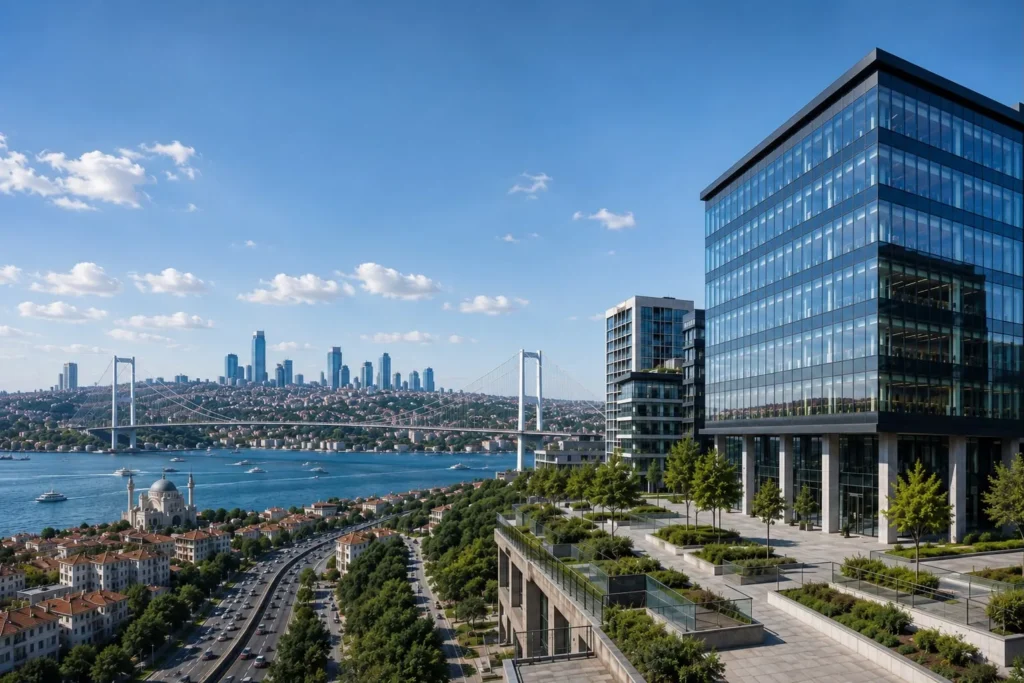
A prime retail unit on Bağdat Avenue and a warehouse corridor near the TEM are both commercial assets in the same city, yet they belong to two very different investment stories. That is the central truth of commercial property investment in Istanbul: the opportunity is real, but the market rewards precision, not broad assumptions.
For sophisticated investors, Istanbul stands apart because it combines density, trade, tourism, domestic consumption, and international relevance in one market. It is a city where office demand can shift by district, where hospitality performance can be seasonal yet powerful, and where mixed-use developments can create stronger resilience than single-use assets. The result is a commercial landscape with depth, but also with clear distinctions between assets that preserve capital and assets that simply look attractive at first glance.
Why commercial property investment in Istanbul attracts serious capital
Istanbul is not compelling merely because it is large. It matters because it functions as Turkey’s financial and commercial center while also serving as a gateway between regional markets. Businesses want access to its consumer base, logistics networks, and talent pool. Investors want exposure to a city where demand is supported by real economic activity rather than speculative narrative alone.
That does not mean every commercial asset performs well. It means the city offers enough scale and sector diversity to build a strategy instead of chasing a listing. A well-positioned office in a business district, a retail unit with durable foot traffic, or a logistics asset linked to transport infrastructure each responds to a different demand engine. This is where disciplined investors gain an edge. They do not ask whether Istanbul is attractive in general. They ask which submarket, which tenant profile, which pricing level, and which holding horizon align with their objectives.
Another advantage is optionality. Some investors prioritize stable yield. Others are seeking medium-term appreciation through redevelopment potential, district transformation, or repositioning. Istanbul can accommodate both, but rarely in the same asset at the same time. Higher income stability may come from mature locations with tighter pricing. Higher upside may come from transitional areas, with more volatility and more execution risk.
The asset classes that matter most
In commercial property investment in Istanbul, asset selection should come before pricing discussions. A low entry price on the wrong commercial type is not value. It is often hidden risk.
Office space
Office demand in Istanbul has become more selective. Companies are still leasing, but the strongest performance tends to concentrate in well-connected, professionally managed buildings with modern specifications. Prime business districts remain relevant because institutional tenants and established firms continue to prioritize access, brand image, and employee convenience.
Secondary office stock can appear attractive on paper, especially when priced below prime benchmarks. Yet vacancy risk, outdated building systems, and weaker tenant demand can erode returns quickly. For investors evaluating office assets, building quality, tenant covenant strength, lease structure, and district-level supply matter far more than square-foot price alone.
Retail property
Retail remains one of the most misunderstood segments. Prime high-street retail can produce strong long-term value when supported by footfall, visibility, and affluent catchment. Neighborhood retail can also work well when anchored by daily-need demand rather than discretionary spending.
The trade-off is sensitivity to micro-location. Two retail units on the same avenue can perform very differently depending on frontage, pedestrian flow, tenant mix, and nearby competition. Investors drawn to retail should pay close attention to the durability of local demand and whether the asset serves destination spending or habitual spending. The latter is often less glamorous and more resilient.
Logistics and industrial assets
For investors with a more strategic, institutionally minded lens, logistics has become increasingly compelling. Istanbul’s role in distribution and trade supports demand for warehouses, last-mile facilities, and operational space linked to major transport routes. This segment can offer strong structural logic, especially where land constraints and infrastructure access support long-term occupancy.
That said, logistics is not a casual entry point. Technical suitability, access corridors, loading capacity, and zoning discipline all matter. A warehouse that looks inexpensive but lacks operational efficiency is rarely a bargain for serious tenants.
Hospitality and mixed-use commercial assets
Hospitality-linked assets and mixed-use projects can be attractive, especially in areas supported by tourism, business travel, and urban regeneration. Their appeal lies in diversified income potential and stronger lifestyle positioning. However, they also require sharper underwriting.
Revenue can fluctuate, operating costs can move, and performance often depends on branding, management quality, and seasonality. These are not passive investments unless the structure is exceptionally well designed.
Location is strategy, not a checkbox
In Istanbul, location analysis needs to go beyond district names. Investors often ask whether the European side or the Asian side offers better commercial prospects. The better question is what type of demand a given location captures.
Some districts are driven by corporate occupancy. Others benefit from tourism and retail intensity. Others are shaped by logistics access, residential catchment, or large-scale urban development. A strong commercial investment sits where its tenant demand is most likely to remain durable through changing market cycles.
Transport matters enormously. Metro access, highway connectivity, airport proximity, and pedestrian patterns all influence liquidity and leasing potential. So does surrounding development quality. A premium asset surrounded by disorganized stock may not achieve its full pricing power. Conversely, an asset within a coherent, well-executed development zone may benefit from a broader lift in perception and tenant confidence.
This is one reason curated sourcing matters. Commercial value is often established before a property reaches the wider market. The strongest opportunities are typically defined by context, not by advertising.
What international investors should evaluate before buying
Cross-border buyers should approach Istanbul with both conviction and discipline. The market can be highly rewarding, but commercial acquisitions require more than a view on price growth.
The first question is legal and structural clarity. Title status, zoning compliance, commercial use permissions, lease validity, and any encumbrances must be reviewed carefully through trusted professionals. This is particularly important in older buildings, redevelopment zones, and assets marketed with unusually optimistic income projections.
The second is income quality. Yield is only as reliable as the tenant, the lease, and the replacement demand if that tenant exits. A long lease with a weak operator can be less secure than a shorter lease in a superior location with stronger reletting prospects.
The third is exit logic. Sophisticated investors do not buy only on entry metrics. They assess who the next buyer is likely to be, what story the asset will tell in three to seven years, and whether the district is becoming more institutional, more supply-heavy, or more competitive. Liquidity matters, especially in commercial real estate where buyer pools are naturally narrower than in residential markets.
Currency exposure should also be part of the analysis. Depending on lease terms, asset class, and market conditions, exchange-rate movement can amplify gains or pressure returns. There is no universal rule here. For some investors, this creates opportunity. For others, it requires a more defensive structure focused on tenant strength and conservative leverage.
How to think about risk in commercial property investment in Istanbul
Risk in this market is rarely one-dimensional. It is usually layered. A property may have an excellent location but weak lease structure. It may offer attractive income but limited resale liquidity. It may sit in a promising corridor but depend on future development that has not yet fully matured.
This is why selective advisory has more value than broad market enthusiasm. Strong commercial investing is a filtering exercise. The goal is not simply to find assets that can work. It is to eliminate those that can quietly underperform.
A disciplined approach typically focuses on five factors: district resilience, asset quality, tenant durability, entry pricing, and exit visibility. If one of those is weak, another must be exceptionally strong to compensate. When several are compromised, the apparent bargain often becomes expensive over time.
For investors who value wealth preservation as much as upside, premium positioning still matters. Better buildings in stronger locations usually command a higher entry price, but they often provide better tenant retention, more stable perception, and greater flexibility at resale. In a city as layered as Istanbul, quality is not cosmetic. It is a risk-management tool.
A firm like RAD Global typically adds value here not by expanding choice, but by narrowing it. For serious buyers, curation is not a luxury. It is protection.
Where the strongest opportunities often emerge
The most attractive commercial opportunities in Istanbul are not always the loudest. They tend to appear where three conditions align: credible location fundamentals, sensible pricing relative to quality, and a clear demand base that does not rely on optimistic assumptions.
Sometimes that means acquiring in established districts where institutional confidence is already visible. Sometimes it means identifying corridors just before broader repricing takes hold. The distinction depends on the investor’s priorities. If the objective is predictable income, maturity usually matters more. If the objective is appreciation with controlled risk, transitional districts with strong infrastructure logic may offer better asymmetry.
What remains constant is the need for precision. Commercial property investment in Istanbul can deliver income, capital growth, and strategic geographic exposure, but only when the asset is matched to a clear investment thesis. The city offers scale, complexity, and genuine upside. It also expects investors to know the difference between movement and momentum.
The right commercial asset should do more than occupy a promising address. It should fit your capital, your timeline, and the legacy you intend to build.