

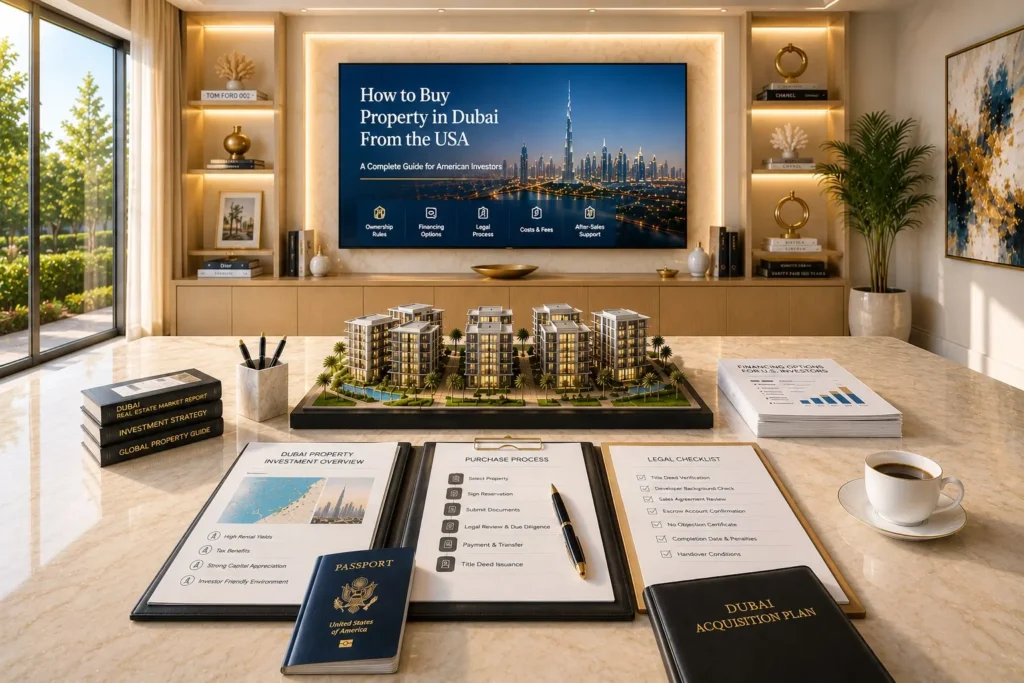
A Dubai property purchase can be completed without leaving the United States, but distance should never reduce diligence. The strongest acquisitions are not driven by a glossy launch event, a promised yield, or a view alone. They begin with a clear investment mandate, verified ownership rights, and a transaction structure designed to protect capital from the first reservation payment.
For American investors asking how to buy property in Dubai from USA, the process is accessible. Foreign nationals can purchase designated freehold property in Dubai, and much of the transaction can be handled remotely through authorized representatives, secure documentation, and coordinated banking. The real work lies in selecting the right asset, understanding the total cost of ownership, and verifying every party involved.
Start With the Investment Mandate, Not the Listing
Dubai is not one market. A waterfront branded residence, a family villa in an established community, a central apartment near business districts, and an off-plan unit in an emerging master plan serve very different objectives. Before reviewing projects, define whether the priority is capital preservation, rental income, a future residence, diversification, or a combination of these.
A disciplined mandate should establish the target budget in U.S. dollars and UAE dirhams, preferred holding period, expected liquidity needs, desired income profile, and tolerance for development risk. The UAE dirham is pegged to the U.S. dollar, which can reduce one layer of currency volatility for American buyers. It does not eliminate investment risk. Pricing, rental demand, service charges, supply pipelines, and resale depth still differ materially by neighborhood and product type.
For a buyer focused on legacy ownership, an established freehold community with proven leasing demand may justify a higher entry price. For an investor seeking a defined growth thesis, a carefully selected off-plan project may offer staged payments and earlier pricing, but it carries execution and handover considerations. Neither route is universally superior. The right decision depends on the quality of the developer, location, payment exposure, and exit strategy.
Understand Foreign Ownership and the Dubai Purchase Structure
Non-UAE nationals may own property in Dubai’s approved freehold areas. These are designated zones where foreign buyers can acquire freehold title, rather than a limited-term interest. The specific title, permitted use, and ownership structure should be confirmed for the individual property, not assumed from a project brochure.
A typical resale acquisition involves agreeing commercial terms, signing a sale agreement, paying a deposit through the appropriate process, obtaining any required no-objection certificate from the developer, and transferring title through the Dubai Land Department. In an off-plan purchase, the buyer signs the developer’s sale and purchase agreement and follows a payment plan linked to construction milestones or scheduled dates.
Remote purchasing is common, but it requires careful authority management. If you will not attend a signing or transfer in person, a properly drafted power of attorney may be required. Its form, notarization, authentication, and local acceptance must be confirmed well before the transfer date. A power of attorney should be narrowly tailored and granted only after independent review of its scope.
Build the True Cost Into Your Underwriting
The listed purchase price is only the first number. A prudent buyer reserves capital for transaction fees, registration charges, broker compensation where applicable, legal and document costs, mortgage-related fees if financing, furnishing, insurance, and ongoing community expenses.
Dubai’s transfer and registration costs are commonly associated with the Dubai Land Department, while off-plan buyers may encounter project-specific administrative charges. Service charges are equally important. They fund the operation and upkeep of common areas, amenities, security, and building systems. In premium towers and resort-style communities, those annual costs can materially affect net rental returns.
Do not underwrite a rental property using headline gross yield. Model realistic vacancy, leasing fees, furnishing replacement, management fees, maintenance, service charges, and a reserve for unexpected expenses. Short-term rental income can be attractive in the right building and location, but it is more operationally intensive and subject to licensing and building rules. Long-term leasing may produce a steadier profile with less turnover.
U.S. buyers should also seek qualified U.S. tax advice before committing. International property ownership can create reporting obligations, income-tax considerations, estate-planning questions, and different treatment depending on whether the asset is held personally or through an entity. The correct structure is personal, financial, and fact-specific. It should not be selected solely for convenience at closing.
Choose Financing and Funds Transfer Early
Cash purchases remain common in Dubai, particularly for overseas acquisitions and off-plan investments. They can improve negotiating leverage and simplify the timeline, but cash must be traceable. Dubai’s banking and real estate systems apply anti-money-laundering and know-your-customer requirements. Buyers should expect to provide identification, proof of address, bank statements, and documentation showing the source of funds and source of wealth.
Mortgage financing may be available to nonresident buyers through UAE lenders, subject to loan-to-value rules, income verification, credit assessment, property eligibility, and bank policy. U.S.-based financing does not automatically translate to Dubai. Buyers considering leverage should obtain an early indication of terms rather than assuming financing will be available after reserving a property.
Coordinate the payment path with your bank, currency provider, and transaction advisors before funds are due. Confirm transfer limits, expected compliance requests, beneficiary details, exchange rates, and timing. A delayed wire can jeopardize a reservation or breach a contractual payment date. Precision at this stage is not administrative detail. It is transaction control.
Conduct Due Diligence That Goes Beyond the Brochure
Premium marketing can be useful context, but it is not an investment memorandum. Due diligence should test the asset’s legal, commercial, and operational reality.
For a resale property, verify the seller’s title, any mortgage or lien position, the property’s service-charge status, occupancy arrangements, and whether the unit matches the description in the agreement. For off-plan, scrutinize the developer’s delivery record, financial standing, escrow arrangements, construction progress, specification schedule, payment plan, and contractual provisions for delay, variation, and default.
Location requires the same discipline. Review access roads, nearby construction, future supply, retail and school infrastructure, public transport, view corridors, and the quality of neighboring developments. An apartment can appear exceptional in isolation yet face an oversupplied rental submarket or a future obstruction that weakens its resale appeal.
A credible advisory team separates evidence from aspiration. It should be able to explain why one floor plan, stack, building, or community is preferable to another, and where the trade-offs sit. At RAD Global, that selectivity is central to the advisory approach: curated access matters only when it is paired with independent investment judgment.
Follow a Controlled Closing Process
Once the asset and structure are approved, keep the execution sequence clear. Your transaction file should include the agreed commercial terms, identification documents, proof of funds, signed contracts, payment confirmations, title or registration records, developer correspondence, and any power of attorney documentation.
Avoid sending funds based only on emailed instructions. Independently verify beneficiary information through known contacts and confirm who is authorized to receive deposits or installment payments. Retain a record of every approval, especially if decisions are being made across time zones by family members, advisors, or corporate representatives.
Before completion, review the final statement of account and make sure the property is delivered as contracted. For a completed unit, this may include a snagging inspection, meter transfers, access cards, parking allocation, and handover documentation. For an investment property, decide in advance whether it will be leased, furnished, held vacant, or positioned for resale after handover.
Plan for Ownership Before You Close
The purchase is the beginning of the asset-management cycle, not the finish line. A high-quality property can underperform if leasing, maintenance, tenant selection, pricing, and resale positioning are treated as afterthoughts.
Establish who will manage the property locally, how approvals will be handled, what return reporting you expect, and when the asset will be reviewed against its original investment case. A yearly review should assess rental performance, expenses, comparable sales, new competing supply, and the case for holding, refinancing, or selling.
Dubai rewards buyers who combine conviction with control. Enter with a defined purpose, acquire only after documentation and underwriting support the decision, and preserve optionality after closing. The property you own should not simply look impressive on a visit. It should have a clear role in the larger architecture of your wealth.