

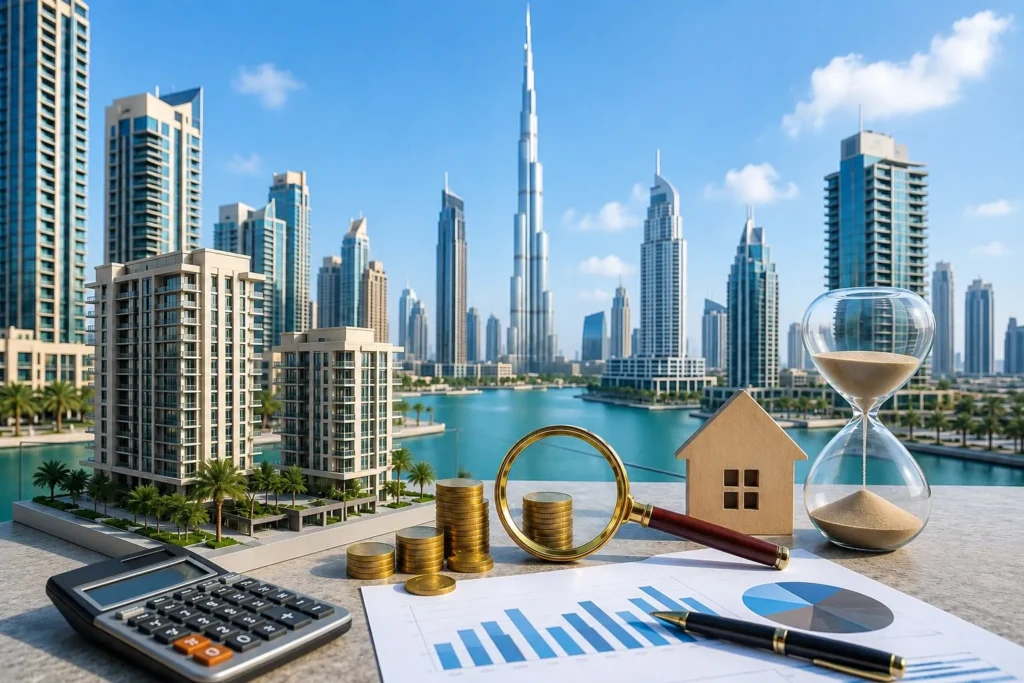
A headline yield can look irresistible until you test what sits underneath it. In Dubai, two apartments with the same price can produce very different outcomes once service charges, vacancy risk, leasing cycles, and tenant profile are properly examined. That is why rental yield in Dubai real estate deserves a more disciplined reading than the marketing shorthand many investors rely on.
For sophisticated buyers, yield is not just a performance figure. It is a signal. It tells you whether an asset is likely to carry itself, how efficiently capital is being deployed, and whether the property fits an income-led strategy or a broader appreciation thesis. In a market as dynamic and segmented as Dubai, yield matters, but context matters more.
What rental yield in Dubai real estate actually means
At its simplest, rental yield is the annual rental income generated by a property relative to its purchase price. Gross yield is the more commonly quoted number. It is calculated by dividing annual rent by the property price and expressing the result as a percentage.
Net yield is the more useful measure for serious investors. It accounts for costs such as service charges, maintenance, leasing commissions, insurance, furnishing where relevant, and periods of vacancy. A property with a strong gross yield can become far less compelling after these variables are included.
This distinction is especially important in Dubai because operating costs can vary significantly by building, community, and asset type. Premium towers with extensive amenities may support strong rents, but they may also carry higher service charges. A lower-cost building in a solid leasing corridor may produce a better net outcome even if the gross number looks less impressive at first glance.
Why Dubai continues to attract yield-focused investors
Dubai remains a standout market because it combines international demand, modern infrastructure, and a business-friendly environment with relatively attractive rental returns compared with many mature global cities. For investors coming from markets where prime residential assets often generate compressed yields, Dubai can appear refreshingly efficient.
That said, the city should not be approached as a single market. It is a collection of micro-markets, each with its own demand drivers, pricing logic, and tenant behavior. Downtown Dubai, Dubai Marina, Business Bay, Jumeirah Village Circle, Palm Jumeirah, and emerging suburban communities all perform differently. Some areas offer stronger immediate income. Others justify lower yield because of branding, scarcity, or stronger long-term capital positioning.
The most disciplined investors understand that high yield is not always the same as high quality. Sometimes the market is pricing in a risk that deserves respect.
What drives rental yield in Dubai real estate
Location remains the first variable, but not in a simplistic sense. The strongest rental assets are usually located where tenant demand is broad, consistent, and defensible. Proximity to business districts, transport corridors, schools, lifestyle amenities, and major employment zones supports occupancy and pricing resilience.
Product quality matters just as much. In Dubai, tenants are highly responsive to design, finishing, building maintenance, and amenities. A well-positioned property in a mediocre building can underperform a better-managed asset in a nearby competitor development. Developer reputation also matters because it often influences build quality, community management, and long-term desirability.
Unit type affects yield in practical ways. Studios and one-bedroom apartments often generate higher percentage yields than larger family units because they are more accessible to a broader tenant pool and carry lower entry prices. Larger apartments may produce stronger absolute rental income, but not always superior yield. This is where strategy becomes personal. An investor seeking cash flow may favor one type of asset, while an investor prioritizing prestige, end-user resale demand, or family occupancy may choose another.
Furnishing strategy can also move the numbers. In short-term or flexible leasing segments, furnished properties may achieve a rental premium, but they bring higher setup costs, more active management, and potentially greater wear. The added return is only attractive if the operational model is handled properly.
Gross yield versus net yield: where decisions are won or lost
Many first-time international investors compare properties using advertised rents and sale prices alone. That is rarely enough. Gross yield can help with quick screening, but it should never be the basis for final selection.
Net yield reveals whether the income profile is genuinely durable. A tower with elevated service charges, frequent tenant turnover, and seasonal vacancy may produce weaker net returns than a simpler asset in a less glamorous address. Likewise, a property purchased at an inflated entry price can struggle to deliver efficient yield even in a strong rental district.
This is where disciplined underwriting protects capital. Every acquisition should be tested against realistic rent assumptions, not best-case projections. The right question is not, what could this property rent for in a strong month? It is, what is the likely stabilized annual income after normal costs and downtime?
How to assess a Dubai rental asset properly
A serious assessment starts with the tenant base. Ask who is most likely to rent the property and why. A unit that appeals to professionals working nearby, families tied to school catchments, or corporate tenants seeking branded convenience tends to perform more predictably than one dependent on narrow or speculative demand.
Then examine supply. Dubai evolves quickly, and new inventory can reshape rental competition within a short period. An area with attractive current yields may face pressure if a large pipeline of similar units is due for delivery. Limited or differentiated supply, by contrast, can protect pricing power.
Ownership costs should be modeled conservatively. Service charges, maintenance exposure, leasing fees, furnishing refresh cycles, and management costs all affect net performance. For overseas buyers, execution quality after purchase is often the difference between a theoretical yield and an actual one.
Exit logic matters too. A yield asset should not be judged only by current rent. It should also be attractive to the next buyer. Buildings with clear market positioning, strong upkeep, and reputable developers generally maintain deeper resale demand. This supports both liquidity and long-term value preservation.
The trade-off between high yield and high-caliber assets
The temptation in any property market is to chase the highest percentage return. In Dubai, that can lead investors toward lower-entry-price assets in secondary locations or heavily saturated segments. Sometimes that works well. Sometimes it creates exposure to weaker tenants, more frequent vacancy, and slower resale performance.
Prime assets often show a different profile. Yield may be slightly lower at entry, but the quality of tenant, depth of demand, and potential for capital appreciation can be stronger. For many affluent investors, the right decision is not the asset with the highest yield on paper. It is the asset with the best balance of income durability, downside protection, and long-term prestige.
This is particularly true for cross-border investors who value simplicity and asset quality alongside returns. A well-selected property in a proven Dubai location may offer a more dependable result than a nominally higher-yielding asset that requires constant intervention.
Short-term versus long-term leasing
Short-term rentals can enhance income in the right building and district, particularly in areas with tourism demand, business travel, and strong seasonal traffic. But this model is more operationally intensive and more sensitive to regulation, occupancy patterns, furnishing standards, and guest management.
Long-term leasing usually offers greater income visibility and less day-to-day oversight. It can be the more suitable route for investors who want cleaner forecasting and a stable hold strategy. Neither model is universally superior. The right answer depends on the property, the location, and the owner’s tolerance for operational complexity.
A smarter way to think about yield
Yield should be treated as part of an investment framework, not the framework itself. The best acquisitions are rarely defined by one metric alone. They work because location, product quality, tenant demand, cost structure, and exit potential all align.
That is why experienced advisors do not simply present a yield figure. They interrogate it. At RAD Global, the focus is not on chasing noise but on identifying assets where income performance supports a broader investment case grounded in quality, discipline, and long-term value.
The most attractive opportunities in Dubai are often not the loudest ones. They are the assets where the numbers make sense, the demand story is credible, and the property still deserves to be owned years after the first lease is signed.