

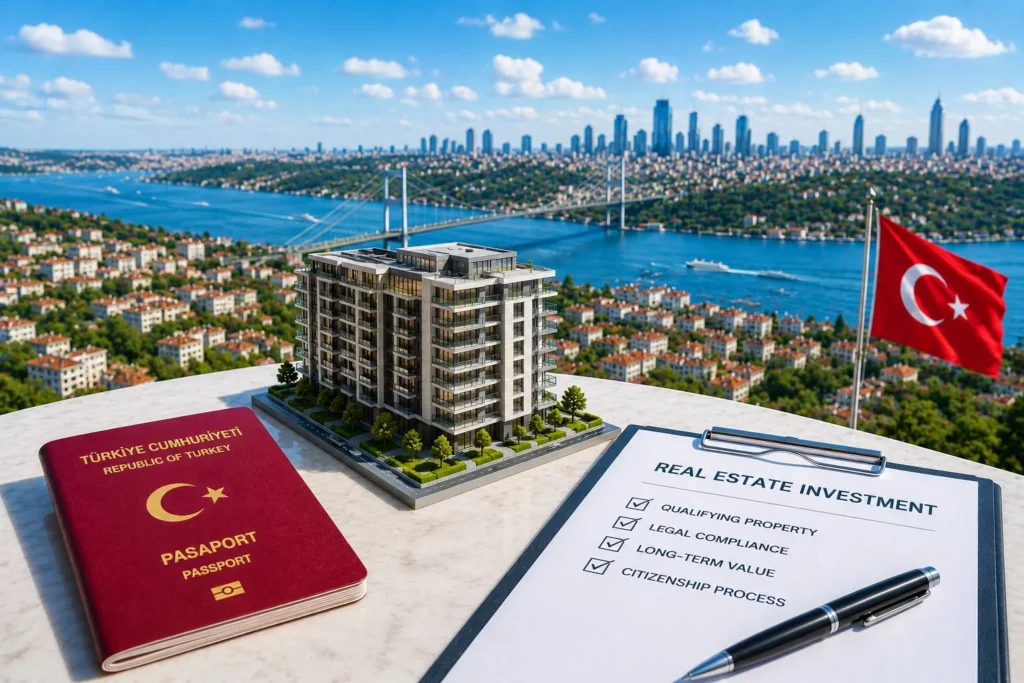
For many international buyers, the real question is not whether Turkey offers citizenship through property. It is whether the asset you purchase to qualify will still look intelligent five years later. That is where turkish citizenship by real estate becomes more than an immigration route. It becomes an investment decision with legal, financial, and portfolio consequences.
Turkey remains one of the few markets where a qualifying real estate acquisition can support a citizenship application while also giving buyers exposure to a large, globally connected economy. Istanbul, in particular, continues to draw capital because it combines lifestyle appeal, rental demand, urban transformation, and pricing that still attracts investors who think in terms of entry point and long-term upside. But citizenship-led buying can go wrong when the process is treated as a paperwork exercise instead of a strategic acquisition.
Why Turkish citizenship by real estate still attracts global investors
The appeal is straightforward. A qualifying property purchase can place an investor on a path to Turkish citizenship, provided the transaction meets current regulatory thresholds and procedural requirements. For internationally mobile families, that creates a second layer of value beyond the property itself.
Yet sophisticated buyers rarely move for one reason alone. They look at optionality. A Turkish passport may matter for family planning, regional mobility, business structuring, or long-term diversification. At the same time, the underlying asset may generate rental income, preserve capital in a strategic market, or position the buyer for later resale in a city with ongoing population growth and infrastructure expansion.
That combination is what makes the program attractive. It is not simply about acquiring a passport. It is about acquiring an asset that serves a wider wealth strategy.
The threshold is only the beginning
Most investors begin with the headline requirement: purchase real estate that meets the minimum value required under the citizenship framework and hold it for the mandated period. That is necessary, but it is not sufficient.
The more consequential question is what sits behind the valuation. Some properties are marketed aggressively because they fit the citizenship threshold, not because they represent sound buying. That distinction matters. Overpaying for an illiquid unit in a weak location can satisfy the legal requirement while compromising the investment case.
Disciplined buyers assess the same factors they would assess in any serious property decision. They examine the district, depth of tenant demand, developer credibility, title integrity, exit liquidity, pricing relative to comparables, and the likely resale audience once the holding period ends. A property selected only because it reaches the qualifying number may solve the first objective and damage the second.
What qualifies and what demands caution
In principle, residential units, commercial assets, land in certain structures, and off-plan purchases may all become part of the conversation, depending on current regulations and title status. In practice, not every qualifying property deserves equal confidence.
Completed assets with clean documentation and proven marketability tend to offer greater clarity. Buyers can inspect the product, assess the neighborhood, test pricing against reality, and estimate lease potential with more confidence. Off-plan opportunities can sometimes offer stronger upside, but they also introduce timing risk, delivery risk, and a more complex path if the citizenship application depends on how the transaction is structured.
Commercial property can appeal to investors focused on income, but it requires sharper analysis of lease profile, tenant quality, and local demand dynamics. A residential apartment in a prime, liquid submarket may ultimately provide a cleaner exit than a commercial unit that looks attractive on paper but serves a narrow buyer pool.
This is where strategic advisory matters. Citizenship programs create urgency, and urgency often leads buyers toward the most heavily promoted inventory rather than the most resilient asset.
How the process usually works
The path is structured, but it should never be rushed blindly. An investor typically starts with property selection, legal checks, valuation compliance, and transaction planning. After purchase, the property must be documented in line with citizenship requirements, including the necessary annotations and formal confirmations tied to the holding commitment. Only then does the citizenship file move through the required application stages.
The sequence matters because errors at the acquisition stage can delay or complicate everything that follows. A mismatch between contract terms, valuation treatment, seller eligibility, title record, or payment documentation can create unnecessary friction. Buyers should expect coordination across real estate, legal, banking, tax, and government-facing steps.
The process is manageable when it is handled with precision. It becomes costly when pieces are assembled reactively after the purchase is already made.
Turkish citizenship by real estate is not just about speed
Some buyers ask one question first: how fast can this be done? Speed matters, especially for families planning education, residency, or business moves. But speed without discipline is rarely a premium strategy.
A rushed purchase can leave an investor with a qualifying property that underperforms the market, carries resale constraints, or sits in a project with weak long-term positioning. It is far better to add a few weeks of due diligence than to spend years holding an asset that was selected for convenience instead of value.
Well-advised investors balance three objectives at once. They want the property to qualify. They want the transaction to be clean. And they want the asset to make sense on its own merits.
Where investors tend to make mistakes
The most common mistake is treating the citizenship threshold as the market price. They are not the same. In some cases, stock is packaged around the threshold because sellers know buyers want a turnkey route. That can distort pricing.
The second mistake is ignoring micro-location. Istanbul is not one market. It is a collection of submarkets with very different demand drivers, tenant profiles, and future liquidity conditions. Two properties with the same ticket size can perform very differently depending on transport links, district maturity, supply pipeline, and local buyer behavior.
The third mistake is underestimating documentation. International investors sometimes assume that if a project is large and well presented, the legal structure must be straightforward. That assumption can be expensive. Title status, permits, valuation handling, and transaction records all require review.
The fourth mistake is focusing only on purchase and not on exit. The holding period will end. At that point, what kind of buyer will want the asset, and why? The best citizenship-aligned purchases are also future resale stories.
What sophisticated buyers look for instead
Sophisticated buyers look for alignment between citizenship utility and asset quality. They want projects backed by credible developers, in districts with enduring demand, at pricing that can be defended against current comparables and future supply. They prefer clarity over noise.
They also understand that the right property depends on investor profile. A family planning partial use may prioritize a premium residential address with stronger lifestyle appeal. A yield-focused investor may accept a more purely commercial thesis. A buyer concerned with capital preservation may prefer established neighborhoods over speculative fringe locations, even if the marketing narrative is less dramatic.
This is why a curated approach outperforms a broad one. Selectivity protects capital.
A program with opportunity and trade-offs
Turkish citizenship by real estate remains compelling, but it is not frictionless and it is not one-size-fits-all. Currency considerations, market cycles, evolving regulations, project-specific risk, and liquidity timing all deserve sober analysis. For some investors, the citizenship benefit justifies a lower-yielding property in a stronger prime location. For others, the better answer may be a more income-oriented asset with a different risk profile.
What matters is whether the property supports the life of the investment after the passport objective is met. That is the standard serious buyers should use.
For investors who value precision over promotion, the strongest outcomes usually come from treating this route as a cross-border investment strategy first and an administrative process second. That mindset tends to produce better assets, cleaner execution, and fewer regrets. Firms such as RAD Global are built around that exact distinction.
The right acquisition should not merely qualify on paper. It should belong in a portfolio you would be confident to hold even if citizenship were never part of the conversation.