

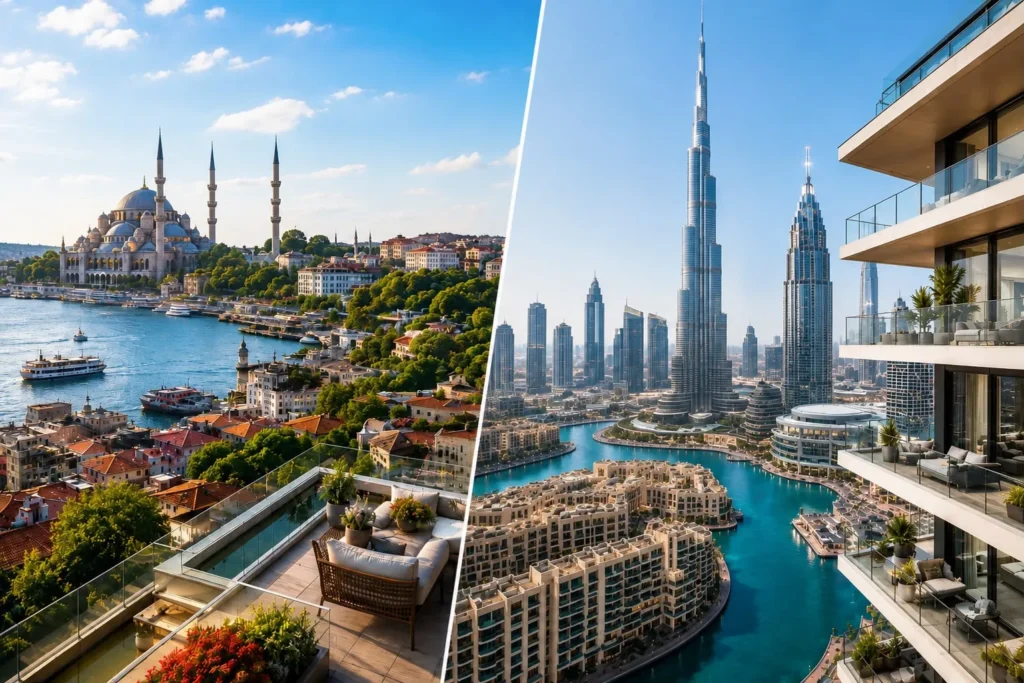
A premium apartment overlooking the Bosphorus and a branded residence above Dubai’s skyline can both satisfy a lifestyle brief. They do not, however, serve the same investment mandate. The Istanbul versus Dubai property decision is fundamentally about what an investor expects capital to do: preserve purchasing power, generate income, support mobility, or create an asset that a family will hold for decades.
For internationally mobile buyers, the strongest choice is rarely the market with the loudest headlines. It is the market whose currency exposure, ownership structure, tenant demand, entry basis, and exit path align with a defined objective. Istanbul and Dubai each offer compelling opportunities, but they reward different forms of conviction.
Istanbul Versus Dubai Property: The Core Difference
Dubai is a globally legible, dollar-pegged real estate market built around international capital, high-quality new development, and transactional efficiency. Its appeal is immediate: a deep expatriate tenant base, established freehold districts, sophisticated master-planned communities, and a market that has become increasingly relevant to global wealth migration.
Istanbul is a far larger and more layered city. It combines domestic depth, tourism, commerce, culture, and a strategic position between Europe, Asia, and the Middle East. Its property market can offer meaningful value when assets are selected with discipline, particularly in locations supported by infrastructure, established neighborhood demand, and credible development quality. It also carries a more complex macroeconomic and currency profile.
Neither market should be treated as a simple substitute for the other. Dubai often suits an investor seeking dollar-linked exposure, operational clarity, and internationally recognizable luxury. Istanbul can suit an investor willing to underwrite a longer horizon, local market nuance, and the potential strategic value of Turkish residency or citizenship eligibility.
Capital Preservation Starts With Currency
For US-dollar-based investors, the most visible distinction is currency. The UAE dirham is pegged to the US dollar, making Dubai property easier to assess in familiar terms. A dollar-based buyer can model acquisition, rental income, service charges, and resale values with relatively limited currency uncertainty.
Turkey is different. Property is frequently marketed to international buyers in foreign-currency terms, while much of the local economy and tenant market operates in Turkish lira. The lira’s volatility can affect the real value of rental income, operating expenses, and the buyer pool at exit. That does not make Istanbul unsuitable for wealth preservation, but it means the purchase price, payment schedule, and intended hold period must be examined more carefully.
A well-positioned Istanbul asset may offer a compelling entry point precisely because the market is not priced with Dubai’s global uniformity. Yet a favorable purchase price is not a strategy on its own. Investors should distinguish between a development with genuine scarcity and one that appears inexpensive only because supply, weak design, or poor location has limited demand.
Rental Income: Depth Matters More Than Advertised Yield
Dubai’s rental market is shaped by a large expatriate population, business formation, tourism, and a high share of residents who rent rather than buy. Prime districts with strong transit, lifestyle infrastructure, waterfront access, or proximity to major employment centers can support broad tenant demand. Short-term rental potential may also be attractive in selected locations, although licensing rules, seasonal patterns, furnishing costs, management fees, and competition need to be included in the underwriting.
The risk in Dubai is paying too much for a projected yield. Gross return figures can look persuasive before service charges, vacancy, furnishing, brokerage, and management costs are accounted for. In some new-build districts, a surge of handovers can soften rental growth or place pressure on resale pricing. The right question is not simply whether a project is premium, but whether its premium is defensible after the next wave of supply arrives.
Istanbul has a more varied tenant ecosystem. Demand comes from local professionals, families, students, corporate occupiers, and visitors, but it is highly neighborhood-specific. A central apartment near business districts, universities, transport links, or established retail can behave very differently from a peripheral development promoted on aspirational renderings alone.
Rental regulation and local leasing practices also require careful guidance. Investors should not rely on a generic yield promise, particularly where rent adjustment rules, building management standards, and furnished-rental regulations may influence actual income. A selective asset in Istanbul can perform well, but local intelligence is essential to separating durable rental demand from a temporary marketing narrative.
Liquidity and Exit Strategy
Dubai generally offers a more standardized experience for international resale. Its freehold market is familiar to overseas buyers, transaction processes are comparatively transparent, and leading communities benefit from a broad international buyer base. Liquidity is strongest for well-priced, well-maintained assets in established locations with recognizable developers and clear use cases.
That said, Dubai is not uniformly liquid. A large number of nearly identical investor units, high annual service charges, or an aggressive off-plan launch cycle can complicate resale. Brand prestige alone does not guarantee an easy exit. Unit orientation, floor level, layout efficiency, delivery timing, and competing inventory all matter.
Istanbul’s exit market tends to be more selective and relationship-driven. A premium residence in an established area with real scarcity may retain strong appeal to domestic and international buyers. However, a foreign investor must consider who will buy the asset in five or ten years, in which currency they will think, and whether the property speaks to local demand as well as overseas demand.
This is where a curated acquisition process creates an advantage. A property should be purchased with its eventual resale audience already in view, not simply because it qualifies for a program or offers an attractive installment plan.
Ownership, Residency, and Citizenship Considerations
Dubai’s ownership framework is especially appealing to buyers who value clarity. Foreign investors can acquire property in designated freehold areas, and certain qualifying investments may support long-term residency pathways. Eligibility thresholds, visa categories, and procedural requirements can change, so these decisions should be validated through qualified legal and immigration professionals rather than sales materials.
Turkey offers a different strategic proposition. Qualifying real estate investment may support an application for Turkish citizenship, subject to prevailing legal requirements, valuation standards, holding periods, and documentation. The widely recognized investment threshold has been $400,000, but investors should confirm current rules before committing capital. Citizenship can hold significance for families seeking greater mobility, a second national connection, or a broader long-term planning structure.
This distinction should be handled with precision. Citizenship eligibility should never override asset quality. An investor who buys an overpriced or illiquid property simply to meet a threshold may secure a legal outcome while compromising the investment outcome. The stronger approach is to identify an asset that meets the relevant criteria while remaining credible on location, design, price discipline, and resale potential.
What Premium Buyers Should Underwrite
The most useful comparison is not city against city, but asset against objective. A Dubai investor may prioritize a completed or near-completion residence in a proven freehold community, where rental comparables and service-charge history can be assessed with greater confidence. An Istanbul investor may prioritize centrality, neighborhood durability, developer execution, and a purchase structure that protects value through a more volatile cycle.
Before proceeding in either market, sophisticated buyers should pressure-test four questions: What is the true all-in cost of ownership? Who is the most likely tenant or end buyer? What new supply could compete with this asset? What is the legal and practical path to resale, leasing, and repatriating funds?
Developer credibility deserves particular attention. Delivery history, financial standing, construction quality, community management, and the terms of the sale agreement are not secondary details. They are part of the asset itself. The same applies to due diligence on title, encumbrances, payment milestones, tax obligations, and post-purchase management.
RAD Global approaches these markets as strategic allocations rather than catalog listings. The objective is to identify the opportunity that fits the investor’s capital profile and personal horizon, then coordinate the right specialists around the transaction.
The Better Market Depends on the Mandate
Choose Dubai when dollar-linked stability, global tenant demand, high-quality new infrastructure, and a comparatively direct ownership environment are central to the brief. It is especially compelling for investors who want an internationally recognizable luxury asset with an efficient operational model.
Choose Istanbul when you see value in a globally significant city with deeper local texture, a broader cultural and commercial base, and the potential relevance of Turkish citizenship by investment. It requires more selectivity and greater comfort with macroeconomic complexity, but can reward investors who acquire the right asset at the right basis.
The best property is not the one that looks strongest in a brochure. It is the one that remains desirable when the market changes, the lease renews, and the next buyer asks the same hard questions you asked before purchasing.